
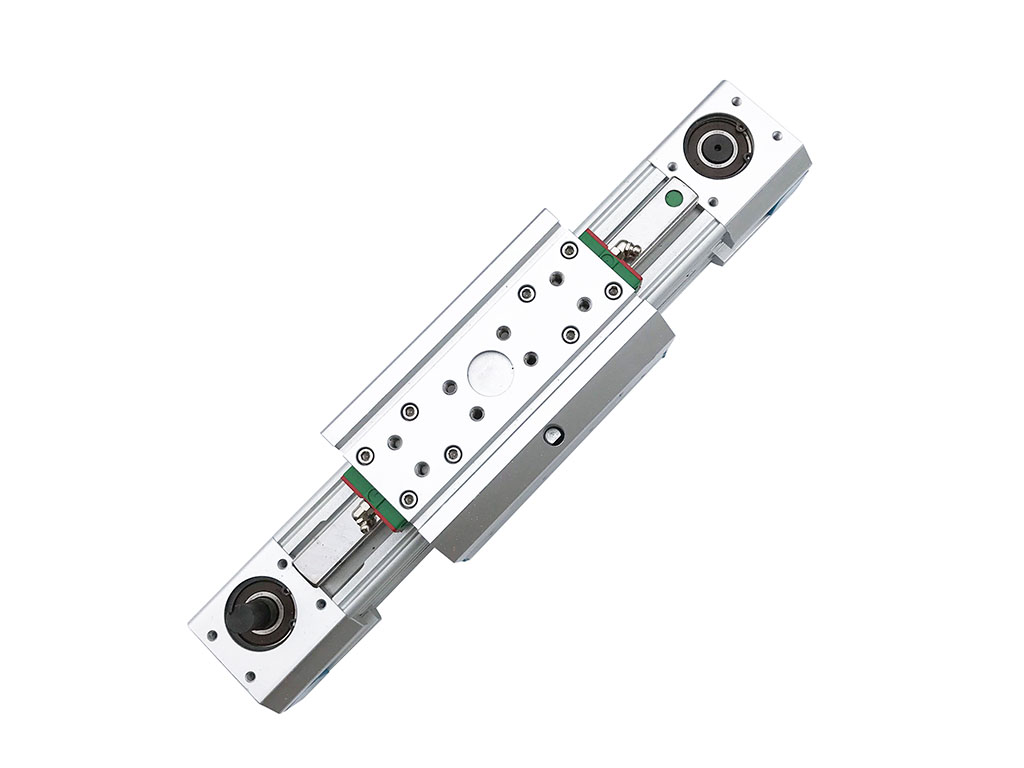
In modern automation and precision machinery, the demand for smooth, accurate, and repeatable movimiento lineal has never been higher. At the core of these systems are guía lineal rails and sliding modules—mechanical assemblies that convert rotational energy into controlled straight-line movement. Understanding their structural principles, technical parameters, and application scenarios is essential for engineers and procurement specialists alike.
Linear Guide Structural Principles and Working Mechanism
A guía lineal system fundamentally consists of two primary components: a hardened steel rail with precisely ground raceways and a matching carriage (slider block) that houses recirculating rolling elements such as balls or rollers. As the carriage moves along the rail, these elements roll between the block and the raceways, transforming sliding friction into rolling friction. This design minimizes resistance, reduces wear, and enables exceptionally smooth motion with high positional accuracy. The Gothic arch profile of the ball races allows for self-alignment, accommodating minor installation misalignments without compromising performance or causing binding.
A sliding module (also called a linear module or linear actuator) builds upon the basic guía lineal by integrating the rail system with a drive mechanism, an aluminum alloy body, and a movable slider platform. Depending on the application, the drive can be a ball screw, a synchronous belt, or a linear motor. In a ball-screw-driven module, the servo motor’s rotary motion is converted into linear motion through a precision ball screw assembly, offering high rigidity and positioning accuracy. Belt-driven variants, by contrast, use a toothed belt to move the slider, making them ideal for long-stroke applications where speed is prioritized over absolute precision.
Linear Guide Key Technical Parameters
When selecting a guía lineal or sliding module, several critical technical specifications must be evaluated:
- Capacidad de carga: The dynamic and static load ratings determine how much weight the system can support in various orientations (radial, reverse-radial, and lateral). High-rigidity guía lineal systems with square-profile blocks can handle complex force conditions without deflection.
- Precision and Repeatability: Ball-screw modules typically offer repeatability up to ±0.005 mm, while belt-driven systems achieve around ±0.05 mm. The accuracy of a guía lineal depends on the grinding tolerance of the raceways and the quality of the rolling elements.
- Longitud del trazo: Ball screw modules are generally recommended for strokes up to 1,500 mm, whereas belt-driven modules can extend to 9,800 mm or even 10,000 mm for specialized roller guide systems.
- Velocidad: Belt-driven guía lineal modules can reach speeds of 5–10 m/s, while ball screw variants are typically limited to slower rates depending on screw lead and diameter.
- Rigidity and Preload: Preloaded guía lineal systems eliminate internal clearance, enhancing rigidity and precision for high-load or high-vibration environments.
Diverse Application Scenarios
The versatility of guía lineal systems and sliding modules has made them indispensable across numerous industries:
- CNC Machining and Machine Tools: High-precision guía lineal rails provide the stable, low-friction motion required for milling, grinding, and cutting operations where micron-level accuracy is mandatory.
- Automation and Robotics: Sliding modules serve as the structural backbone of pick-and-place machines, palletizers, and robotic arms, enabling reliable repetitive motion in assembly lines.
- Medical and Semiconductor Equipment: The smooth, contamination-free operation of precision guía lineal systems is critical for diagnostic devices, wafer handling systems, and automated laboratory equipment.
- Photovoltaic and Renewable Energy: In solar tracking systems, guía lineal actuators adjust panel angles to follow the sun, maximizing energy capture while withstanding outdoor environmental stresses.
- Packaging and Logistics: Belt-driven linear modules with long strokes and high speeds are widely deployed in sorting systems, conveyor transfers, and automated warehousing solutions.
From the hardened steel raceways of a basic guía lineal to the integrated multi-axis motion platforms of advanced sliding modules, these components form the foundation of contemporary linear motion technology. By carefully matching structural design, drive type, and technical parameters to specific operational requirements, engineers can achieve optimal performance, longevity, and cost-efficiency. Whether in a high-speed packaging line or a precision CNC center, the right guía lineal system ensures that every movement is smooth, accurate, and reliable.